01 — Tool
Tool
A thing you use that does not get consumed. An awl, a cast-iron pan, a #7 jointer plane, a fermentation vessel.
example: "round awl · Osborne #477 · sharpened 2025-12"
HideSync is a free, locally-hosted PM/ERP for makers, artisans, and small workshops. It tracks your tools, materials, techniques, workflows, projects, and events with full lineage, and stores everything as portable JSON manifests in a folder you own. It is also the reference implementation of OPG-L 0.6, the open standard Rillmark builds on. The application itself is proprietary and free to use; the standard it implements and the data it writes stay open.
If you have ever documented your craft in a spreadsheet, a Notion database, a dead app, or a folder of PDFs that only you can parse, you know what HideSync is for. It is not a cloud, not a subscription, not a walled garden.
HideSync is three small services that run on your machine. They write JSON manifests into a Git-tracked folder you choose. Those files are yours. They remain readable in any text editor long after any version of this software has stopped shipping updates.
You will recognise it, we hope, as something made by someone who does the thing.
Runs on your laptop. Data never leaves unless you choose to share a project. If the house loses internet, the shop keeps working.
Every record is a JSON manifest in a Git-tracked folder. Open it in any
editor. Diff it with git. Back it up with rsync. The schema is OPG-L 0.6, an open standard.
The point isn't to raise and exit. The point is to still be around when your apprentice's apprentice opens your notebook.
The hard part of documenting a craft isn't writing things down. It's naming the things worth writing about. HideSync picks six, just six, and uses them consistently. They're small enough to keep in your head and general enough to fit leatherwork, kitchen work, wood, metal, fibre, and fermentation. These are the primitives of OPG-L 0.6, the same six that any conformant implementation must support, whatever its surface.
A thing you use that does not get consumed. An awl, a cast-iron pan, a #7 jointer plane, a fermentation vessel.
A thing you use up. Leather, wood, flour, wax, pigment, thread, solder. Tracked by origin and lot when that matters.
A repeatable way of doing something. Saddle stitch, pâte brisée, dovetail layout, brine cure. The unit of learned skill.
An ordered sequence of techniques applied to materials using tools. A recipe, a cut list, a build order.
What you set out to make, and the plan for making it. The bag for your sister, Sunday's loaf, the chair you're halfway through.
A dated record of work actually done. Sharpening. Receiving a hide. Finishing a project. The doing that ties history together.
These are photographs of the working app, taken in the tutorial workshop that ships with it. The worked example is a Black Forest cake rather than a wallet, deliberately: the grammar doesn't care what the work is. Swap the sponge for an 8oz russet hide and nothing about the structure changes.
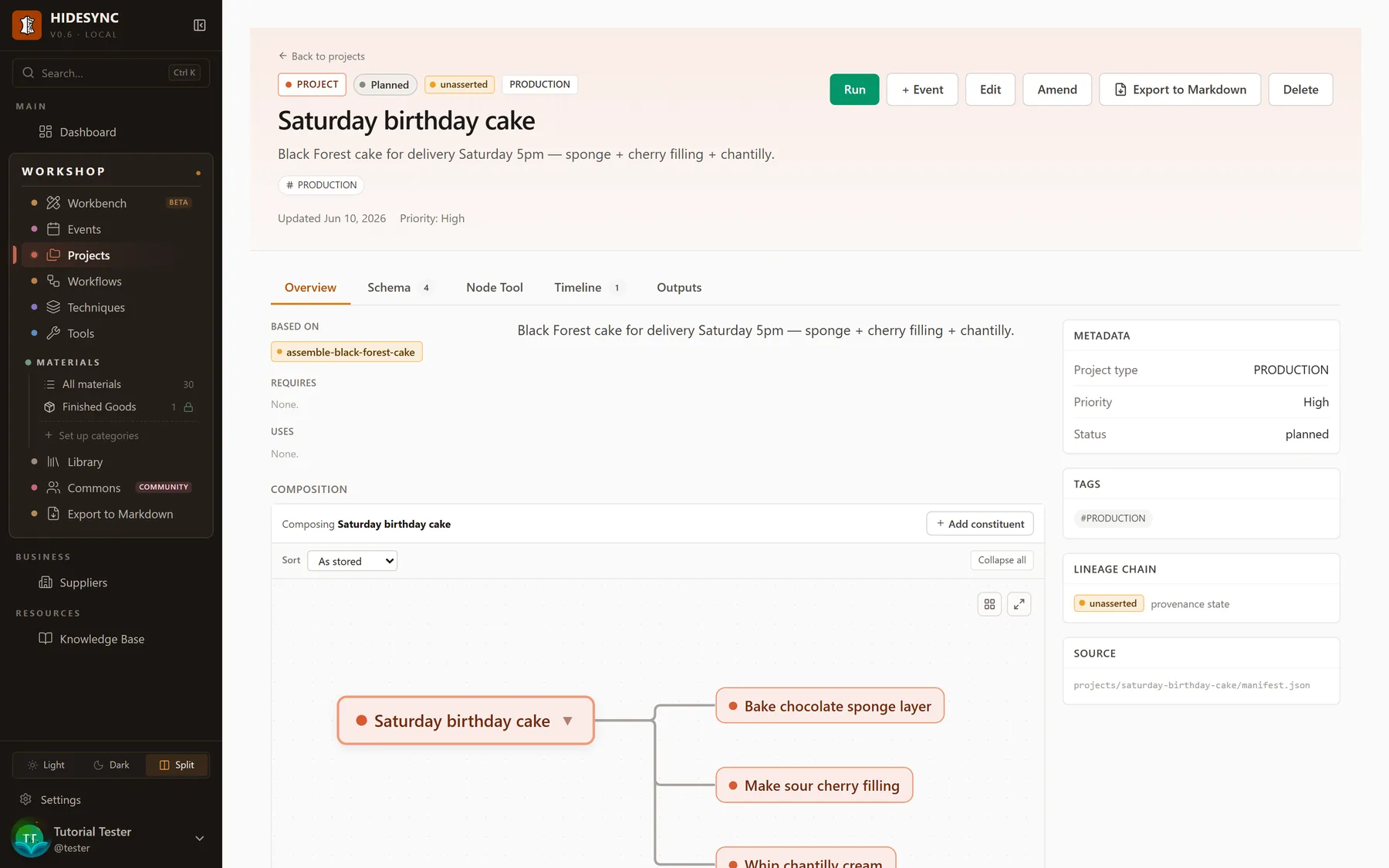
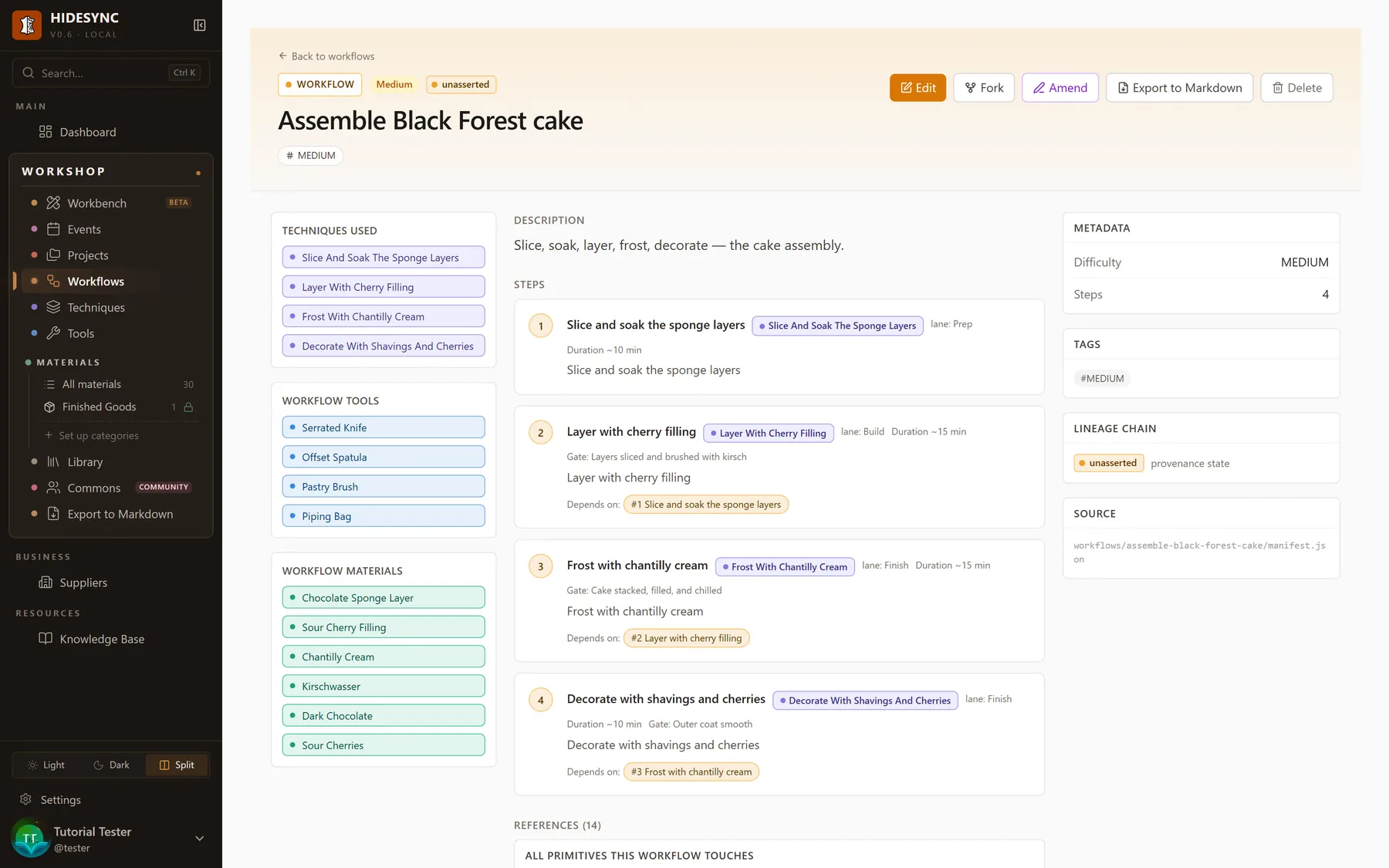
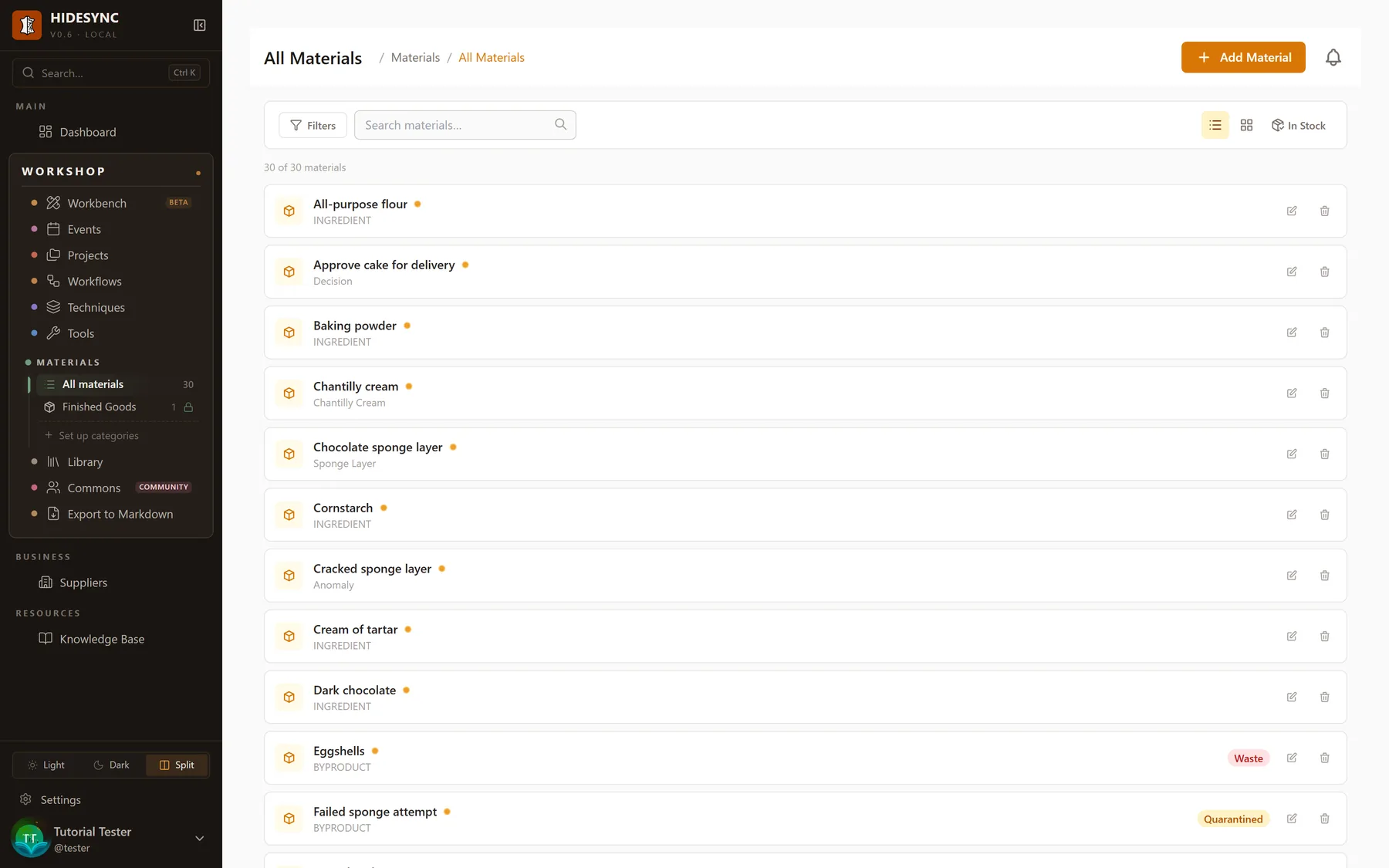
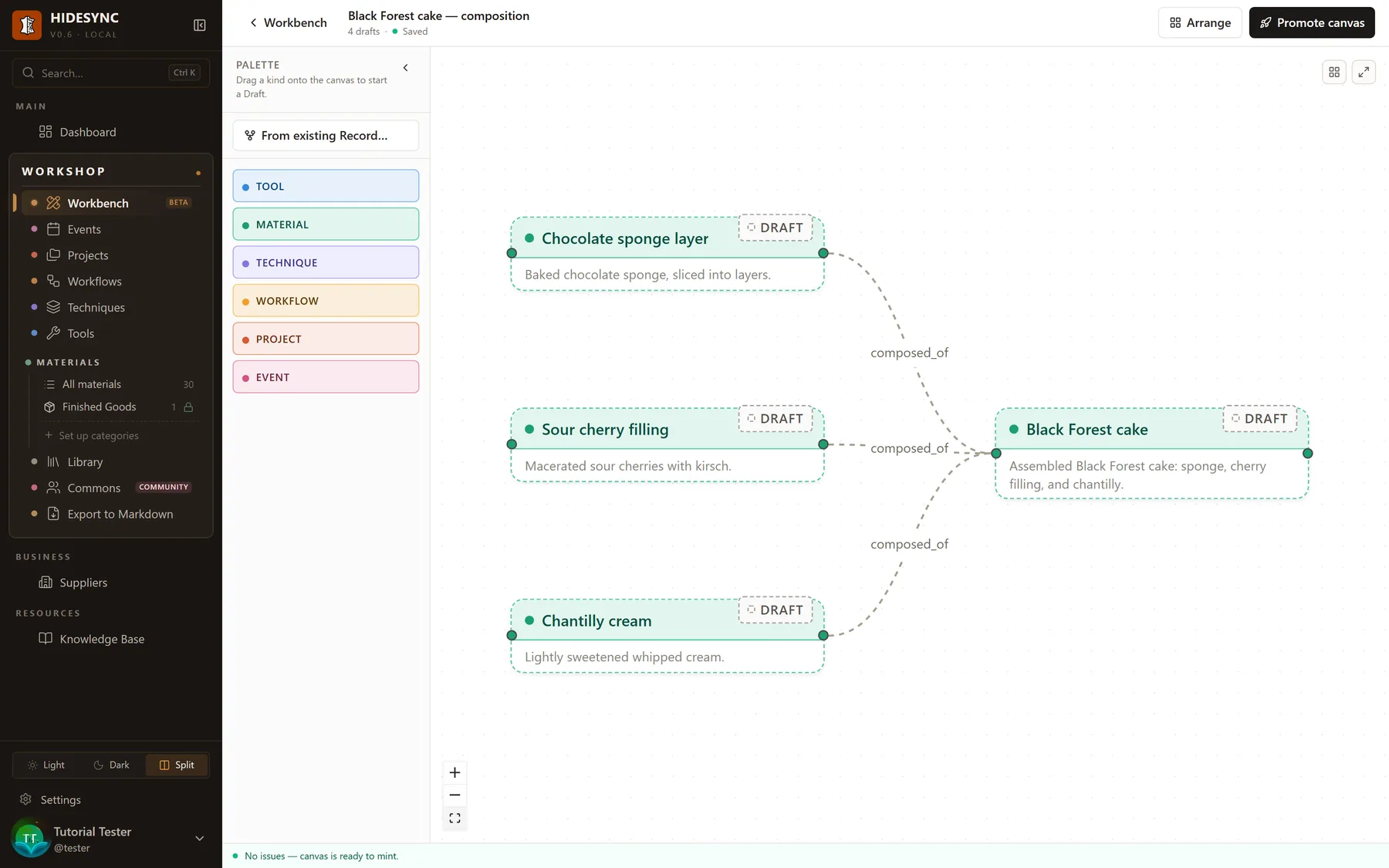
Underneath your local files sits a proto-commons, a public catalogue of techniques, tools, and materials that lives on GitHub today. Think: the dictionary, not the printing press. Every entry is attributed, versioned, and free to fork.
The commons is the reason the primitives exist in the form they do: named the same way by a leatherworker in Porto and a knife-maker in Osaka, so their notes can cross the gap between crafts without losing precision.
Commons publication is opt-in per record. Use HideSync at private visibility indefinitely; the proto-commons grows only from what you explicitly publish.
When the Foundation is established, the proto-commons migrates into the full Commons, stewarded by the Rillmark Commons Foundation under the OPG-L standard. The catalogue's substance (the named techniques, the cited references, the contributors' attributions) carries forward unchanged. More on Rillmark's two-layer structure →
HideSync writes JSON manifests into a Git-tracked folder you choose. One file per record. The folder layout mirrors the primitives. The schema is OPG-L 0.6, an open standard, portable to any conformant implementation that exists or will exist. If HideSync vanishes tomorrow, your archive still opens in any editor, diffs in any git client, and parses in any JSON tool.
Version it with Git (it already is, manifest-as-source-of-truth). Back it up with the same tool you use for everything else. Share a single project folder with a collaborator by email or pull request. Nothing about this requires us.
tools/
  round-awl.json         # Tool — inherited from grandfather
  osborne-477-pricking.json
  ...
materials/
  wickett-craig/
    a-104.json           # 8oz nat. russet, 2025-11
    a-107.json
techniques/
  saddle-stitch.json     # with variants & spi table
  edge-burnish.json
workflows/
  card-holder-v3.json    # 14 steps
projects/
  2026-m-reyes-belt/
    manifest.json
    events/
      2026-04-02-cut.json
      2026-04-03-stitched.json
commons/                 # symlinked, read-only
  → ~/hidesync/commons/
I studied mechatronics and computer science for three semesters, then left. Leather is where I landed: self-taught, badly at first and better now, for about ten years. What the lecture halls left me came along, into the craft and later into this tool. I built a version of this software for myself some time ago. It worked. Then it stopped working, because I had made it the way someone makes a thing for themselves: quickly, with shortcuts, with every decision I regretted still in the code.
So I started over. This time with the patience that the subject deserves. The primitives came from watching what I actually did in the shop and what I actually wrote in the margins of my notebooks. They're not a clever framework. They're the smallest set that kept showing up.
HideSync is free, and will remain free; Ko-fi tips are welcome, but nothing is ever gated. If you use it and it helps you, I would like to hear about it. If you use it and it frustrates you, I would like to hear about that more. Write: [email protected].